


Moving antiques or large furniture safely in Petaluma starts with planning before anyone lifts the piece. Evaluate size, weight, access, stairs, doorways, parking, and protection before moving day. That review helps determine whether the item should be disassembled, how it should be wrapped, which route is practical, and what crew or equipment the move may require.
For homeowners, renters, and anyone relocating a valuable or oversized piece, the hardest part is often not the driving. It is getting the item safely from its current position to the truck and then into its new location. MG Movers offers furniture moving services for pieces that need more planning than a standard box or chair.
Why Antiques and Large Furniture Need More Planning
A large dresser, armoire, dining table, sectional, cabinet, or antique case piece can create several challenges at once. The item may be heavy, but weight alone does not determine how difficult the move will be. Shape, balance, construction, fragile components, floor conditions, stairs, turns, and the width of the exit route all matter.
Antiques require an additional layer of care because age can affect how a piece responds to handling. Older glue joints may be less forgiving. Veneer, decorative trim, glass, mirrors, casters, doors, and original hardware may need special attention. An item that has been moved several times or repaired in the past may also have weak points that are not obvious at first glance.
The National Park Service recommends planning each step before handling museum objects and using appropriate padding, carts, dollies, and other equipment rather than treating a move as routine. Its guidance on handling, packing, and moving objects reinforces a basic principle that applies well to household antiques too: understand the object and the route before moving it.
Measure the Furniture and the Route Before Moving Day
One of the most useful things you can do before a specialty move is take measurements. Do not stop with the furniture itself. Measure the spaces the item must pass through at both the pickup and destination.
Record the approximate height, width, depth, and any unusually long or protruding sections of the furniture. Then measure the narrowest doorway, hallway, stair landing, turn, gate, or entrance along the route. If there is a low ceiling over a staircase or a tight turn at the top or bottom, include that too.
| Planning Factor | What to Check | Why It Matters |
|---|---|---|
| Furniture dimensions | Height, width, depth, removable parts | Shows whether the piece can travel intact or may need partial disassembly |
| Doorways | Opening width, height, door swing, trim | Helps identify the narrowest point before lifting begins |
| Hallways and turns | Width, corners, ceiling height, obstacles | A piece may clear a doorway but still fail to make the next turn |
| Stairs | Width, landings, railings, turns, exterior steps | Changes lifting, balance, crew positioning, and equipment needs |
| Parking and loading | Truck location, carry distance, street access | A longer carry changes how the move should be staged |
| Item condition | Loose parts, glass, old repairs, fragile finishes | Helps determine how the piece should be protected and handled |
Photos make these measurements much more useful. A picture of the furniture tells part of the story. A picture of the staircase, doorway, landing, driveway, or curbside access often tells the rest.
Why Petaluma Homes Can Create Unique Access Challenges
Petaluma has a mix of newer residential properties, apartments, older homes, and historic areas near downtown. The City of Petaluma identifies multiple historic districts and resources in its planning documents, including historic residential areas and the historic commercial core. You can review the city’s General Plan and historic district resources for broader context on the city’s older building stock.
For a furniture move, the significance is practical. Older houses were not necessarily designed around modern sectionals, oversized mattresses, large entertainment furniture, or today’s standard moving equipment. An entry may be narrower than expected. A staircase may have a tight landing. A hallway may turn immediately after a doorway. Original wood floors, railings, or trim may also call for more deliberate protection.
This is where using Petaluma movers who can review local access conditions becomes useful. The route from the room to the truck should be part of the moving plan, not something the crew discovers after the furniture is already wrapped and lifted.
How Should You Prepare an Antique Before It Is Moved?
Preparation depends on the construction of the item. Start by removing loose contents. Empty drawers, cabinets, and shelves unless the mover specifically recommends otherwise. Loose objects add weight, can shift unexpectedly, and may damage the interior of the piece.
Remove detachable glass shelves, loose mirrors, removable shelves, and other components that can be packed separately. Do not assume an antique should be completely disassembled. Some older furniture was not designed to come apart repeatedly, and aged joints or hardware can be vulnerable.
Look for existing scratches, loose trim, cracks, repaired legs, unstable feet, lifting veneer, or other fragile areas. Take clear photos before the move. This gives both you and the moving crew a reference for the item’s condition and helps identify areas that may need extra protection.
When Does Furniture Disassembly Make Sense?
Disassembly can make a difficult move much simpler when the furniture was designed to come apart. Removing table legs, bed components, sectional pieces, detachable tops, shelves, or certain doors can reduce weight and make tight turns easier.
The important point is to decide before the piece becomes stuck in a doorway. If an item is close to the available clearance, the crew should know that before lifting begins.
Antique furniture needs a more cautious approach. A removable component on a modern dining table may be straightforward. An old joint held together with aged hardware or glue may not be. The item, its condition, and its construction should determine whether disassembly is appropriate.
Plan for reassembly at the destination
Any piece that comes apart should have its hardware controlled and identified. Screws, bolts, brackets, shelves, and removable components should stay organized so the item can be reassembled correctly at the destination.
MG Movers can handle furniture disassembly and reassembly when appropriate for the piece. Sharing photos before the move helps determine whether that work should be included in the plan.
How Do You Move Large Furniture Through Stairs and Narrow Hallways?
Stairs change the mechanics of a move. The person on the lower side of a heavy piece may be dealing with a different share of the load than the person above. Turns and landings also limit where crew members can stand while maintaining control.
Before moving day, inspect the full staircase from both directions. Look at the narrowest section, railing position, landing dimensions, ceiling height, light fixtures, wall corners, and what happens immediately after the final step.
A furniture item that technically fits the staircase width may still be difficult to turn at the landing. That is why measuring only the first doorway is not enough.
Narrow hallways present a similar problem. A long cabinet may fit through the entry but lack enough turning radius to enter the next room. In those situations, planning the orientation of the item before it reaches the hallway helps avoid unnecessary handling.
How Should Valuable Furniture Be Protected?
Protection should match the item. Moving blankets can help protect finished surfaces. Stretch wrap can help keep protective materials in place where appropriate. Glass, mirrors, carved details, corners, and projecting hardware may need additional attention.
Floors and the surrounding home matter too. Moving a valuable piece is not only about protecting the furniture. Door jambs, railings, walls, hardwood floors, tile, and stairs are part of the working environment.
The goal is risk reduction through preparation and controlled handling. MG Movers can move furniture, pianos, and other specialty items, but no responsible moving plan should depend on an absolute promise that nothing can ever go wrong. Careful planning, appropriate protection, and accurate access information are what reduce avoidable risk.
What Changes When the Specialty Item Is a Piano?
Pianos require a separate access review because they combine substantial weight with an awkward shape and a specific balance point. The piano type matters, but so do the stairs, exterior steps, landings, door width, path to the truck, and final placement.
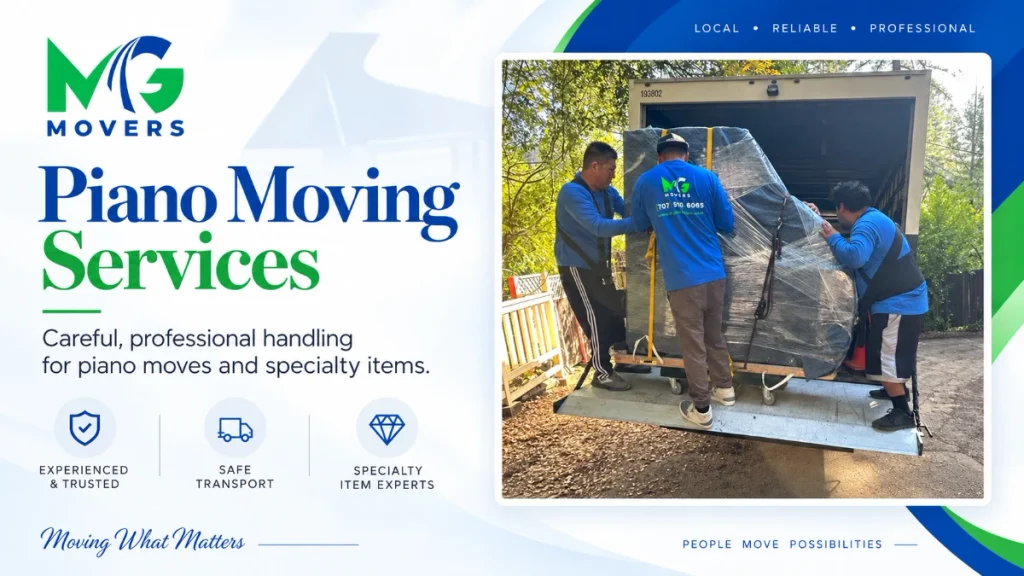
MG Movers provides piano moving for upright, baby grand, grand, and other piano moves that require advance planning.
If stairs are involved, send photos from multiple angles. Include the entire staircase rather than only the first few steps. A mover needs to see landings, turns, rails, overhead clearance, and the space available at the top and bottom.
The destination matters just as much as the pickup. A piano that exits one property easily can still present a very different challenge at the new home.
Downtown Petaluma Moves Need a Parking and Loading Plan
For a downtown move, truck placement can become part of the specialty-item plan. Large furniture is easier to control when the carry route is direct. A long carry from the truck, a shared entrance, busy sidewalk, limited curb access, or tight building entry can change how the crew stages the move.
Before moving day, verify where a moving truck can lawfully stop and how close it can get to the entrance. If you rent or live in a multi-unit property, ask the property manager whether there are specific move-in hours, loading procedures, gate requirements, or shared-area rules.
Do not assume that because a regular car fits near the property, a moving truck will have the same access. Send a photo of the street or driveway if there is any doubt.
What We Need to Quote a Specialty Move
A specialty moving quote is more useful when it includes enough information to evaluate the item and the route. For an antique, piano, oversized cabinet, heavy table, sectional, or similar piece, provide the following:
- Item type: Tell us exactly what is being moved, including whether it is antique, fragile, unusually heavy, or oversized.
- Origin and destination: Provide the pickup and delivery locations so both access points can be considered.
- Approximate dimensions: Include height, width, and depth whenever possible.
- Stairs: Mention interior or exterior stairs, the number of flights, landings, and turns.
- Narrow access: Describe tight doors, hallways, gates, elevators, driveways, or difficult corners.
- Photos: Send clear photos of the item and any access condition that may affect how it is moved.
These details help the moving team decide how much preparation the job requires before the truck arrives. They also reduce the chance that an important access issue appears for the first time on moving day.
What Should You Check Before Hiring a Mover for Valuable Furniture?
For a household move within California, confirm that the company is authorized to perform household moving services and understand the estimate and moving agreement before work begins. The California Bureau of Household Goods and Services provides a consumer guide to household moving that explains licensing, visual inspections, written estimates, inventories, and other consumer protections. :contentReference[oaicite:6]{index=6}
For antiques and high-value pieces, also describe the item clearly during the quote process rather than waiting until the crew arrives. If a piece has an unusual condition, significant sentimental value, delicate components, or known repairs, mention those details early.
Frequently Asked Questions About Moving Antiques and Large Furniture in Petaluma
How do I know if an antique should be disassembled before moving?
Do not assume an antique should come apart simply because it looks modular. Older joints, veneer, hardware, and previous repairs can be fragile. Share photos and dimensions with the mover first. If disassembly is appropriate, identify removable components and hardware before lifting. If not, plan the route around moving the piece intact.
Can MG Movers move a piano in Petaluma?
MG Movers can handle piano moves in Petaluma, including moves that require extra access planning. Before requesting a quote, share the piano type, approximate dimensions, pickup and delivery locations, stairs, landings, narrow doors, and photos. Those details help determine the practical route and preparation needed for the move.
What should I measure before moving large furniture?
Measure the furniture’s height, width, and depth, then measure the narrowest parts of the route at both locations. Include doors, hallways, stairways, landings, gates, and tight corners. It is also helpful to photograph overhead obstructions, railings, and any area where the piece will need to turn.
Can large furniture be moved through a historic Petaluma home?
Often it can, but older homes may require more access planning because doorways, staircases, turns, and room layouts can differ from newer construction. Measure the full route rather than just the entrance. Photos of stairs, halls, doors, and the furniture itself can help determine whether disassembly or a different handling plan is needed.
What should I send when requesting a quote for an antique or specialty item?
Send the item type, pickup and delivery locations, approximate dimensions, information about stairs or narrow access, and several clear photos. Include photos of the furniture as well as doorways, staircases, driveways, or other challenging areas. The more complete the access information is, the easier it is to plan the move accurately.
If you need to move an antique, piano, oversized cabinet, sectional, heavy table, or another difficult piece in Petaluma, send MG Movers the item details before moving day. Include photos, approximate dimensions, stairs, narrow access, and pickup and delivery information when you Request a Free Moving Quote so the team can review the move and plan the route before lifting begins.